RightStart™ Mathematics Level F
RightStart™ Mathematics Level F covers ratios, percentages, and pre-algebra foundations. It prepares students for middle-school math while continuing RightStart's hands-on, visual approach.
Lessons taught & reviewed by Nicole Thomas · Updated October 2026
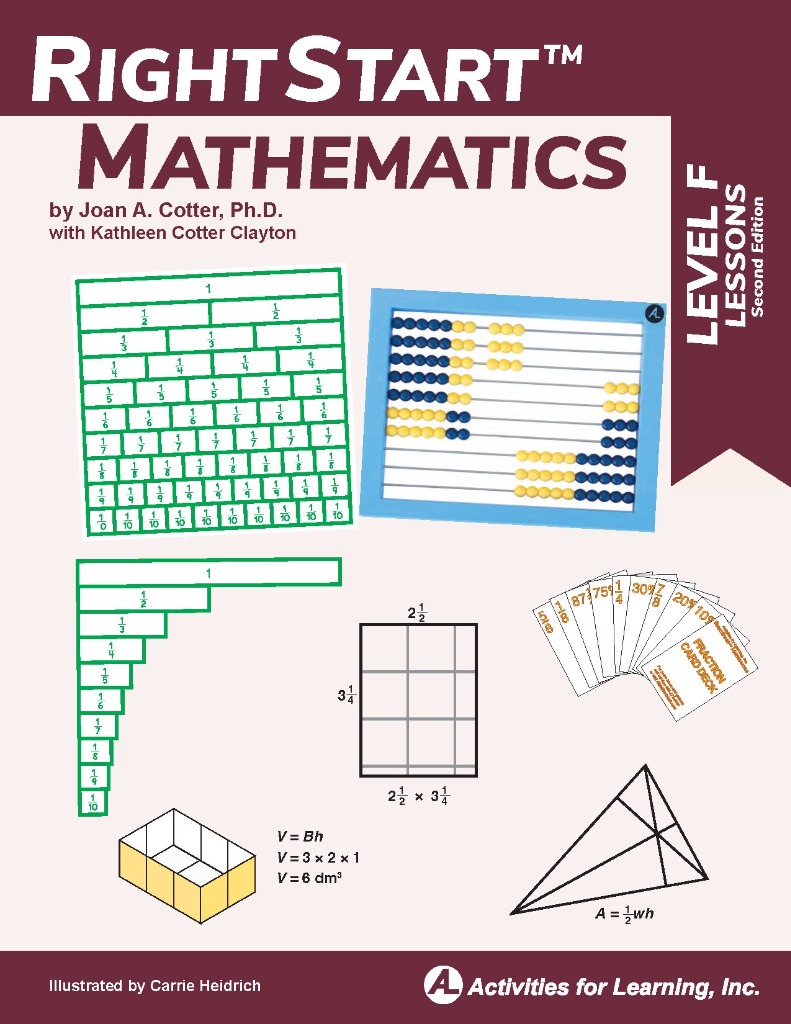
What RightStart™ Mathematics Level F Covers
- Numeration: squares, square roots, and exponents
- Long division by two-digit divisors
- Decimals: operations to the thousandths and dividing by decimals
- Fractions: unlike denominators, multiplying, and dividing
- Percents, probability, and combinations
- Measurement: cubic units and dimensional analysis conversions
- Coordinate systems: ordered pairs and graphing equations
- Geometry: scaling figures and inscribed constructions
RightStart™ Mathematics Level F Table of Contents
RightStart Mathematics Objectives for Level F. Numeration: Finds squares and square roots; reads, writes, rounds, and compares numbers. Multiplication and Division: Applies commutative, associative, and distributive properties; multiplies multiples of 10 and exponents; does division using factors; does long division by a two-digit divisor. Problem Solving: Solves two-step problems involving fractions and decimals; uses dimensional analysis to solve problems. Decimals and Percents: Rounds and compares decimals to the thousandths; adds and subtracts decimals to three decimal places; divides decimals by whole numbers and decimals; understands and uses simple percentages; solves percentage problems with a calculator. Fractions: Adds and subtracts mixed fractions with unlike denominators; converts between mixed numbers and improper fractions; finds equivalent fractions on the multiplication table; multiplies and divides various fractions. Measurement: Understands cubic units (cm3, dm3, in3, ft3, and yd3); uses dimensional analysis to convert measurements; converts measurements between SI and US customary. Probability and Combinations: Calculates the probability of an event; calculates probabilities; finds probabilities using combinations. Coordinate Systems: Finds locations using a coordinate system; makes line plots and interprets data; finds points on a Cartesian coordinate system using ordered pairs; places negative points on a Cartesian coordinate system; plots equations on a Cartesian coordinate system. Geometry: Classifies shapes by attributes; scales figures; constructs regular polygons inscribed in a circle; constructs inscribed circles in polygons; constructs inscribed squares in triangles.
150 lessons
First 65 lessons now — more arrive through Dec 2026
Lesson 1·Review Cotter Abacus and Addition Strategies
Available nowLesson 2·Review Mental Adding
Available nowLesson 3·Review Subtraction Strategies
Available nowLesson 4·Review Multiplication Strategies
Available nowLesson 5·Review The Math Balance
Available nowLesson 6·Review Division Strategies
Available nowLesson 7·Review Finding Remainders
Available nowLesson 8·Remainders on the Math Balance
Available nowLesson 9·Review Short Division
Available nowLesson 10·Review Reminders after Dividing by Nine
Available nowLesson 11·Review Introducing Check Numbers
Available nowLesson 12·Review Using Check Numbers
Available nowLesson 13·Review Multivides
Available nowLesson 14·Order of Operations
Available nowLesson 15·Making Expressions
Available nowLesson 16·Square Numbers
Available nowLesson 17·Cubic Numbers and Higher Powers
Available nowLesson 18·Composing Expressions
Available nowLesson 19·Expanded Notation with Exponents
Available nowLesson 20·Multiplying and Dividing by Tens
Available nowLesson 21·Dividing with a Horizontal Line
Available nowLesson 22·Review and Games 1
Available nowLesson 23·Review Fraction Basics
Available nowLesson 24·Tenths and Hundredths
Available nowLesson 25·Thousandths
Available nowLesson 26·Adding with Decimals
Available nowLesson 27·Subtracting with Decimals
Available nowLesson 28·Averaging
Available nowLesson 29·More Averaging
Available nowLesson 30·Rounding Decimals
Available nowLesson 31·Rounding and Comparing Decimals
Available nowLesson 32·Review and Games 2
Available nowLesson 33·Review Multiplying by Two Digits
Available nowLesson 34·Dividing by Divisors Greater Than Ten
Available nowLesson 35·Two-Digit Multivides
Available nowLesson 36·Multiplying Tenths by a Whole Number
Available nowLesson 37·Dividing Decimals by Whole Numbers
Available nowLesson 38·Multiplying Tenths by Tenths
Available nowLesson 39·Multiplying Hundredths
Available nowLesson 40·Dividing by Tenths
Available nowLesson 41·Dividing by Hundredths
Available nowLesson 42·Dividing by Decimals
Available nowLesson 43·Assessment Review 1
Available nowLesson 44·Review Games
Available nowLesson 45·Assessment 1
Available nowLesson 46·‘Octopus Multiplying’
Available nowLesson 47·Short Division to Long Division
Available nowLesson 48·Trial Quotients in Long Division
Available nowLesson 49·Enrichment Expanding Short Division
Available nowLesson 50·Checking Division
Available nowLesson 51·Remainder Forms after Dividing
Available nowLesson 52·Long Division Problems
Available nowLesson 53·More Long Division Problems
Available nowLesson 54·Review and Games 3
Available nowLesson 55·Rectangular Area Problems
Available nowLesson 56·Square Patterns
Available nowLesson 57·More Square Patterns
Available nowLesson 58·Square Roots
Available nowLesson 59·Square Root Problems
Available nowLesson 60·Squares on Right Triangles
Available nowLesson 61·Area of Tangrams
Available nowLesson 62·Area of Parallelograms
Available nowLesson 63·Review and Games 4
Available nowLesson 64·Review Area on the Geoboard
Available nowLesson 65·Area of Triangles on the Geoboard
Available nowLesson 66·Introducing Formulas
Lesson 67·Area of Triangles
Lesson 68·Triangle Area Problems
Lesson 69·Applying Triangle Area
Lesson 70·Area of Trapezoids
Lesson 71·Area Problems
Lesson 72·Review and Games 5
Lesson 73·Introduction to Volume
Lesson 74·Volume of Prisms
Lesson 75·Volume of Geometric Solids
Lesson 76·Volumes in Other Units
Lesson 77·Volume Problems
Lesson 78·Assessment Review 2
Lesson 79·Review Games
Lesson 80·Assessment 2
Lesson 81·Skip Counting with Fractions
Lesson 82·Fraction Skip Counting Practice
Lesson 83·Adding and Subtracting Simple Fractions
Lesson 84·Adding Fractions to Two
Lesson 85·Equivalent Fractions on the Multiplication Table
Lesson 86·Simplifying Fractions
Lesson 87·Simplifying Fractions with Factors
Lesson 88·Equivalent Fractions
Lesson 89·Adding Fractions with Same Denominators
Lesson 90·Subtracting Fractions with Like Denominators
Lesson 91·Adding Fractions with Unlike Denominators
Lesson 92·More Adding Fractions
Lesson 93·Subtracting Fractions
Lesson 94·Adding and Subtracting Fractions
Lesson 95·Fraction Problems
Lesson 96·Review and Games 6
Lesson 97·Multiplying Fractions and Whole Numbers
Lesson 98·Fraction of a Fraction
Lesson 99·Multiplying Proper Fractions
Lesson 100·More Multiplying Proper Fractions
Lesson 101·Multiplying Mixed Numbers
Lesson 102·Canceling
Lesson 103·Solving Fraction Problems
Lesson 104·Review and Games 7
Lesson 105·Dividing Fractions on a Fraction Chart
Lesson 106·Dividing Fractions with Algorithm #1
Lesson 107·One Divided by a Fraction
Lesson 108·Whole Numbers Divided by a Fraction
Lesson 109·Dividing Fractions with Algorithm #2
Lesson 110·Comparing Fraction Division Methods
Lesson 111·Fraction Word Problems
Lesson 112·Review and Games 8
Lesson 113·Percentages
Lesson 114·Percentage Word Problems
Lesson 115·More Percentage Word Problems
Lesson 116·Combinations
Lesson 117·More Combinations
Lesson 118·Introducing Probability
Lesson 119·Probability with Spinners
Lesson 120·Probability with Dice
Lesson 121·Review and Games 9
Lesson 122·Analyzing Patterns
Lesson 123·Finding Cities on a Map
Lesson 124·Introducing Coordinate Systems
Lesson 125·Negative Coordinates
Lesson 126·Cartesian Coordinate System
Lesson 127·Graphing Equations
Lesson 128·Making Equations on the Math Balance
Lesson 129·Solving for Unknowns on the Math Balance
Lesson 130·Review and Games 10
Lesson 131·Converting Units within the SI System
Lesson 132·Converting Units within the US System
Lesson 133·Converting Area and Volume Units
Lesson 134·Converting between Systems
Lesson 135·Converting Compound Units
Lesson 136·Converting Rates
Lesson 137·Enrichment Converting Capacity Units
Lesson 138·Enrichment Converting Mass Units
Lesson 139·Review and Games 11
Lesson 140·Review Drawing Horizontal Lines
Lesson 141·Review Drawing Lines with the Triangles
Lesson 142·Classifying Quadrilaterals
Lesson 143·Scaling a Figure
Lesson 144·Drawing a Regular Polygon in a Circle
Lesson 145·Drawing Inscribed Circles
Lesson 146·Drawing Inscribed Squares
Lesson 147·Arithmetic Review
Lesson 148·Arithmetic Games
Lesson 149·Geometry and Measurement Review
Lesson 150·Final Assessment
Find the Right Starting Point
RightStart™ Mathematics levels don't map neatly to school grades, so the free placement test is the reliable way to confirm Level F is the right fit — it only takes a few minutes, and it's more than okay if it points a level back.
Take the placement testBooks & Materials for Level F
Nicole's video lessons follow the Second Edition books, so you'll work from your own copy of the Level F materials alongside the videos. Our textbooks page shows exactly what you'll need and where to buy each piece.
Find the Level F books & materials