RightStart™ Mathematics Level D
RightStart™ Mathematics Level D develops multiplication and division and introduces fractions. Games and the abacus keep practice hands-on while students build fluency and problem-solving skills.
Lessons taught & reviewed by Nicole Thomas · Updated October 2026
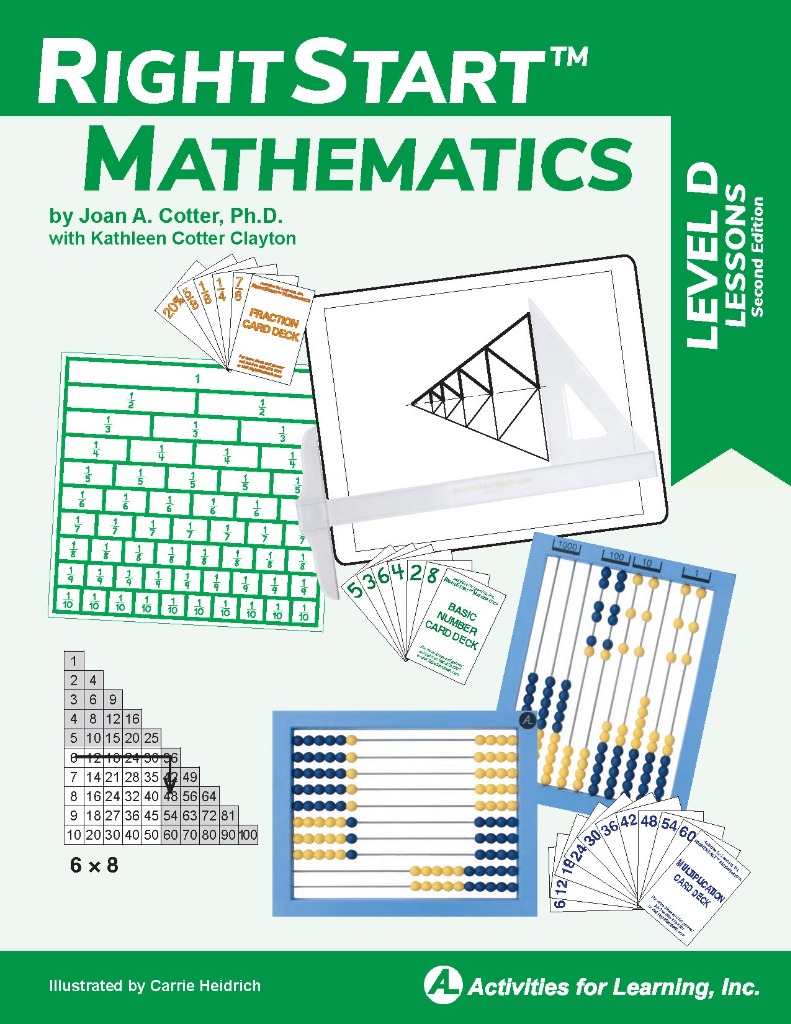
What RightStart™ Mathematics Level D Covers
- Numeration: rounding and numbers to the millions
- Multiplication facts to 10 × 10 and the properties
- Multiplying a 4-digit number by a 1-digit number
- Division facts and missing factors
- Fractions, equivalences, and mixed numbers
- Time, money, area, and measurement (US & metric)
- Geometry, angles, data, and problem solving
RightStart™ Mathematics Level D Table of Contents
RightStart™ Mathematics Objectives for Level D: Numeration — Rounds numbers to the nearest 10, 100, and 1000; reads, writes, and compares numbers to the millions. Addition and Subtraction — Adds 2-digit numbers mentally and 4-digit numbers on paper; understands subtraction as a missing addend. Multiplication — Knows the facts to 10 × 10; applies the commutative, associative, and distributive properties; multiplies multiples of 10 and a 4-digit number by a 1-digit number. Division — Understands division as equal groups and as a missing factor; knows the division facts. Fractions — Understands a/b as a divided by b; understands mixed numbers; compares and finds equivalences on the fraction chart. Time and Money — Tells time to the minute; solves elapsed-time problems; adds and subtracts dollars and cents. Measurement — Finds perimeter and area in customary and metric units; measures in grams, kilograms, and liters. Geometry — Knows angles of 30°, 45°, 60°, 90°, 180°, and 360°; categorizes shapes by attributes; constructs shapes with drawing tools. Data — Gathers and interprets data with charts and graphs. Problem Solving — Solves two-step problems with all four operations; solves problems in more than one way; identifies and explains patterns.
140 lessons
First 65 lessons now — more arrive through Dec 2026
Lesson 1·Review Entering Quantities on the Abacus
Available nowLesson 2·Review Addition Strategies
Available nowLesson 3·Review Hundreds with Place-Value Cards
Available nowLesson 4·Review Thousands and Side 2 of the Abacus
Available nowLesson 5·Review Trading on Side 2 of the Abacus
Available nowLesson 6·Review Mental Adding
Available nowLesson 7·Review Subtraction Strategies
Available nowLesson 8·Review Subtracting on Side 2 of the Abacus
Available nowLesson 9·Review Traditional Subtracting on the Abacus
Available nowLesson 10·Review Arrays
Available nowLesson 11·Review Multiplication in Arrays
Available nowLesson 12·Chinese Checkerboard Problem
Available nowLesson 13·Multiplying by Two
Available nowLesson 14·More Multiplying by Two
Available nowLesson 15·Multiples of Two and Four
Available nowLesson 16·Multiples of One
Available nowLesson 17·Multiples of Eight
Available nowLesson 18·The Commutative Property
Available nowLesson 19·Multiples of Ten and Nine
Available nowLesson 20·Multiples of Five
Available nowLesson 21·Multiples of Three
Available nowLesson 22·Multiples of Six
Available nowLesson 23·Multiples of Seven
Available nowLesson 24·The Associative Property for Multiplication
Available nowLesson 25·Shortcut Multiplying
Available nowLesson 26·Review and Games 1
Available nowLesson 27·Multiplication Problems
Available nowLesson 28·The Multiplication Table
Available nowLesson 29·Area on the Multiplication Table
Available nowLesson 30·Evens and Odds on the Multiplication Table
Available nowLesson 31·Comparing Addition and Multiplication Tables
Available nowLesson 32·The Short Multiplication Table
Available nowLesson 33·Using the Short Multiplication Table
Available nowLesson 34·Finding Missing Factors
Available nowLesson 35·Division Problems
Available nowLesson 36·Introducing Parentheses
Available nowLesson 37·Assessment Review 1
Available nowLesson 38·Review Games
Available nowLesson 39·Assessment 1
Available nowLesson 40·Multiplying on the Math Balance
Available nowLesson 41·Distributive Property on the Math Balance
Available nowLesson 42·Order of Operations with a Calculator
Available nowLesson 43·Reviewing Place Value with a Calculator
Available nowLesson 44·Estimating by Rounding to Tens
Available nowLesson 45·More Rounding
Available nowLesson 46·Story Problems with Rounding
Available nowLesson 47·Review and Games 2
Available nowLesson 48·Composing 6-Digit Numbers
Available nowLesson 49·Composing Larger Numbers
Available nowLesson 50·Comparing Larger Numbers
Available nowLesson 51·Enrichment The Billions
Available nowLesson 52·Introducing Remainders
Available nowLesson 53·Remainders after Dividing by Nine
Available nowLesson 54·Check Numbers
Available nowLesson 55·Identifying Multiples
Available nowLesson 56·Review and Games 3
Available nowLesson 57·Enrichment Building Pascal’s Triangle
Available nowLesson 58·Enrichment Pascal’s Triangle Patterns
Available nowLesson 59·Checking Subtraction by Adding Up
Available nowLesson 60·Checking Subtraction with Check Numbers
Available nowLesson 61·Multiplying with Multiples of Tens
Available nowLesson 62·More Multiplying with Multiples of Tens
Available nowLesson 63·Multiplying Multi-Digit Numbers Horizontally
Available nowLesson 64·Multi-Digit Multiplication
Available nowLesson 65·Using Check Numbers with Multiplication
Available nowLesson 66·Review and Games 4
Lesson 67·Unit Fractions
Lesson 68·Fractions as Division
Lesson 69·Non-Unit Fractions
Lesson 70·Fraction Pairs That Total One
Lesson 71·The Ruler Chart
Lesson 72·Adding Halves and Fourths
Lesson 73·Quarters of an Hour
Lesson 74·Fractions of a Dollar
Lesson 75·Gallons and Quarts
Lesson 76·Enrichment Musical Notes
Lesson 77·Assessment Review 2
Lesson 78·Review Games
Lesson 79·Assessment 2
Lesson 80·Making One with Fractions
Lesson 81·Comparing Fractions
Lesson 82·Fraction Line
Lesson 83·Multiples Patterns
Lesson 84·More Multiples Patterns
Lesson 85·Growing Geometric Patterns
Lesson 86·Numeric Patterns
Lesson 87·Chinese Checkerboard Revisited
Lesson 88·Review and Games 5
Lesson 89·Months of the Year
Lesson 90·Calendar for One Year
Lesson 91·Calendars for Two Years
Lesson 92·Measuring and Graphing Lengths
Lesson 93·Scoring Corners™ with a Bar Graph
Lesson 94·Reading a Bar Graph
Lesson 95·Constructing a Bar Graph
Lesson 96·Review and Games 6
Lesson 97·Time to the Minute
Lesson 98·Adding Minutes
Lesson 99·Time Problems
Lesson 100·Finding Perimeter in Feet and Inches
Lesson 101·Square Miles
Lesson 102·Measuring Areas
Lesson 103·Finding Areas
Lesson 104·Area of Tangram Pieces
Lesson 105·Area and Perimeter Comparisons
Lesson 106·Finding Perimeter and Area of Squares
Lesson 107·Enrichment Graphing Perimeter and Area
Lesson 108·Review and Games 7
Lesson 109·Finding Factors
Lesson 110·Area and Perimeter Problems
Lesson 111·Measuring in Grams
Lesson 112·Liters and Kilograms
Lesson 113·Measurement Problems
Lesson 114·Naming Angles
Lesson 115·Measuring Sides in Triangles
Lesson 116·Measuring Angles in Triangles
Lesson 117·Dollars and Cents
Lesson 118·More Dollars and Cents
Lesson 119·Money Problems
Lesson 120·Review and Games 8
Lesson 121·Review Drawing Horizontal Lines
Lesson 122·Review Drawing Lines with a 30-60 Triangle
Lesson 123·Drawing Shapes in a Hexagon
Lesson 124·Drawing 30° and 60° Lines in a Circle
Lesson 125·Drawing 45º Lines in a Square
Lesson 126·Drawing 45° Lines in a Circle
Lesson 127·Drawing Congruent Figures
Lesson 128·Completing the Whole
Lesson 129·Finding a Fraction of a Figure
Lesson 130·Organizing Quadrilaterals
Lesson 131·Drawing Symmetrical Figures
Lesson 132·Congruent Shapes
Lesson 133·Arithmetic Review
Lesson 134·Arithmetic Games
Lesson 135·Time, Money, and Problem Solving Review
Lesson 136·Time, Money, and Problem Solving Games
Lesson 137·Data, Fraction, and Geometry Review
Lesson 138·Fraction Games
Lesson 139·Final Assessment
Lesson 140·Geometry Panels
Find the Right Starting Point
RightStart™ Mathematics levels don't map neatly to school grades, so the free placement test is the reliable way to confirm Level D is the right fit — it only takes a few minutes, and it's more than okay if it points a level back.
Take the placement testBooks & Materials for Level D
Nicole's video lessons follow the Second Edition books, so you'll work from your own copy of the Level D materials alongside the videos. Our textbooks page shows exactly what you'll need and where to buy each piece.
Find the Level D books & materials