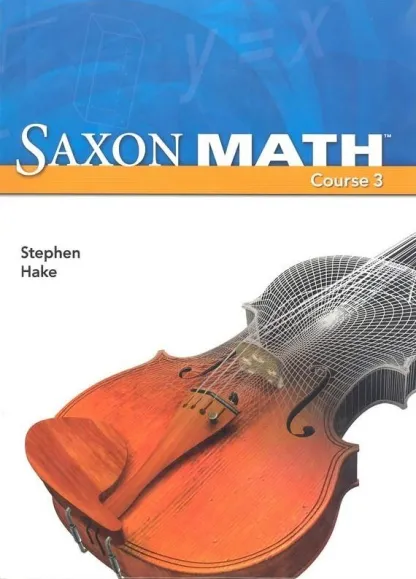
Saxon Math Course 3
Saxon Math Course 3 is the classroom (school) edition for eighth grade, covering pre-algebra through early algebra concepts in a hardcover textbook format. Nicole the Math Lady provides video lessons and grading for the 4th edition, preparing students for Algebra 1.
Homeschooling? See Saxon Algebra 1/2 (homeschool edition)Lessons taught & reviewed by Nicole Thomas · Updated October 2026
What Saxon Math Course 3 Covers
- Solving multi-step equations and inequalities
- Functions and graphing
- Exponents, roots, and scientific notation
- Geometry and the Pythagorean theorem
- Data analysis and probability
Saxon Math Course 3 Table of Contents
The full lesson-by-lesson scope and sequence for Saxon Math Course 3, so you know exactly what your student will learn before you start.
133 lessons
Lesson 1·Number Line: Comparing and Ordering Integers
Lesson 2·Operations of Arithmetic
Lesson 3·Addition and Subtraction Word Problems
Lesson 4·Multiplication and Division Word Problems
Lesson 5·Fractional Parts
Lesson 6·Converting Measures
Lesson 7·Rates and Average/ Measures of Central Tendency
Lesson 8·Perimeter and Area
Lesson 9·Prime Numbers
Lesson 10·Rational Numbers/ Equivalent Fractions
Lesson 11·The Coordinate Plane + Activity(Coordinate Plane)
Lesson 12·Percents
Lesson 13·Decimal Numbers
Lesson 14·Adding and Subtracting Fractions and Mixed Numbers
Lesson 15·Evaluation/ Solving Equations by Inspection
Lesson 16·Powers and Roots
Lesson 17·Irrational Numbers
Lesson 18·Rounding and Estimating
Lesson 19·Lines and Angles
Lesson 20·Polygons
Lesson 21·Triangles
Lesson 22·Pythagorean Theorem + Activity (Pythagorean Puzzle)
Lesson 23·Distributive Property/ Order of Operations
Lesson 24·Multiplying and Dividing Fractions
Lesson 25·Multiplying and Dividing Mixed Numbers
Lesson 26·Adding and Subtracting Decimal Numbers
Lesson 27·Multiplying and Dividing Decimal Numbers
Lesson 28·Transformations + Activity (Describing Transformations)
Lesson 29·Laws of Exponents
Lesson 30·Scientific Notation for Large Numbers
Lesson 31·Ratio
Lesson 32·Repeating Decimals
Lesson 33·Classifying Quadrilaterals
Lesson 34·Adding Integers/ Collecting Like Terms
Lesson 35·Probability
Lesson 36·Subtracting Integers
Lesson 37·Proportions/ Ratio Word Problems
Lesson 38·Similar and Congruent Polygons
Lesson 39·Multiplying and Dividing Integers/ Multiplying and Dividing Terms
Lesson 40·Areas of Combined Polygons
Lesson 41·Using Properties of Equality to Solve Equations
Lesson 42·Circumference of a Circle
Lesson 43·Area of a Circle
Lesson 44·Drawing Geometric Solids + Activity 1(Sketching Prisms and Cylinders Using Parallel Projection) & Activity 2 (Sketching Pyramids and Cones) & Activity 3 (Create a Multiview Drawing) & Activity 4 (One-Point Perspective Drawing)
Lesson 45·Functions
Lesson 46·Volume
Lesson 47·Surface Area + Activity (Surface Area of a Box)
Lesson 48·Solving Proportions Using Cross Products/ Slope of a Line
Lesson 49·Ratio Problems Involving Totals
Lesson 50·Solving Problems Using Scientific Notation
Lesson 51·Graphing Functions
Lesson 52·Percent of a Whole
Lesson 53·Solving Rate Problems with Properties and Equations
Lesson 54·Solving Multi-Step Equations
Lesson 55·Graphing Transformations
Lesson 56·Negative Exponents/ Scientific Notation for Small Numbers
Lesson 57·Using Unit Multipliers to Convert Measures/ Converting Mixed-Unit to Single-Unit Measures
Lesson 58·Solving Problems uUsing Measures of Central Tendency
Lesson 59·Angle Relationships
Lesson 60·Nets of Prisms, Cylinders, Pyramids, and Cones + Activity (Net of a Cone)
Lesson 61·The Slope-Intercept Equation of a Line
Lesson 62·Operations with Small Numbers in Scientific Notation
Lesson 63·Solving Percent Problems with Equations
Lesson 64·Experimental Probability
Lesson 65·Area of a Parallelogram + Activity(Area of a Parallelogram)
Lesson 66·Collect, Display, and Interpret Data
Lesson 67·Sequences
Lesson 68·Graphing Solutions to Inequalities on a Number Line
Lesson 69·Rational Numbers, Non-Terminating Decimals, and Percents/ Fractions with Negative Exponents
Lesson 70·Using a Unit Multiplier to Convert a Rate
Lesson 71·Applications Using Similar Triangles
Lesson 72·Special Right Triangles
Lesson 73·Percent of Change
Lesson 74·Probability Multiplication Rule
Lesson 75·Direct Variation
Lesson 76·Solving Direct Variation Problems
Lesson 77·Probability Simulation + Activity 1 (Probability Simulation) & Activity 2 (Design and Conduct a Simulation)
Lesson 78·Percent Change of Dimensions
Lesson 79·Multiple Unit Multipliers
Lesson 80·Formulas for Sequences
Lesson 81·Simplifying Square Roots
Lesson 82·Area of a Trapezoid
Lesson 83·Volumes of Prisms and Cylinders
Lesson 84·Inequalities with Negative Coefficients
Lesson 85·Products of Square Roots
Lesson 86·Transforming Formulas
Lesson 87·Adding and Subtracting Mixed Measures/ Polynomials
Lesson 88·Scatter Plots + Activity (Make a Scatter Plot and Graph a Best-fit Line)
Lesson 89·Central Angles and Arcs
Lesson 90·Graphing Equations Using Intercepts
Lesson 91·Probability of Dependent Events
Lesson 92·Selecting an Appropriate Rational Number
Lesson 93·Surface Area of Cylinders and Prisms
Lesson 94·Volume of Pyramids and Cones
Lesson 95·Scale Drawing Word Problems
Lesson 96·Review of Proportional and Non-Proportional Relationships
Lesson 97·Solving Problems with Two Unknowns by Graphing
Lesson 98·Sets
Lesson 99·Sampling Methods + Activity (Random Number Generators)
Lesson 100·Effect of Scaling on Perimeter, Area, and Volume
Lesson 101·Areas of Rectangles with Variable Dimensions/ Products of Binomials
Lesson 102·Equations with Exponents
Lesson 103·Graphing Pairs of Inequalities on a Number Line
Lesson 104·Slant Heights of Pyramids and Cones
Lesson 105·Geometric Measures with Radicals
Lesson 106·Recursive Rules for Sequences
Lesson 107·Relations and Functions
Lesson 108·Inverse Variation
Lesson 109·Surface Areas of Right Pyramids and Cones
Lesson 110·Compound Interest + Activity (Calculating Interest and Growth
Lesson 111·Geometric Probability
Lesson 112·Growth and Decay
Lesson 113·Line Plots/ Box-and-Whisker Plots
Lesson 114·Volume, Capacity, and Mass in the Metric System
Lesson 115·Compound Average and Rate Problems
Lesson 116·Reviewing the Effects of Scaling on Volume
Lesson 117·Volume and Surface Area of Compound Solids
Lesson 118·Similar Solids
Lesson 119·Consumer Interest
Lesson 120·Converting Repeating Decimals to Fractions
Lesson 121·Non-Linear Functions + Activity 1 (Modeling Functions) & Activity 2 (Using the Graph of a Quadratic Function) & Activity 3 (Maximization)
Lesson 122·Volume and Surface Area of a Sphere
Lesson 123·Ratios of Side Lengths of Right Triangles
Lesson 124·Using Scatterplots to Make Predictions + Activity (Using a Scatterplot to Make Predictions)
Lesson 125·Calculating Area as a Sweep
Lesson 126·Relative Sizes of Sides and Angles of a Triangle
Lesson 127·Division by Zero
Lesson 128·Significant Digits
Lesson 129·Sine, Cosine, Tangent
Lesson 130·Complex Fractions
Lesson 131·Rationalizing a Denominator
Lesson 132·Proof of the Pythagorean Theorem
Lesson 133·Number Line: Comparing and Ordering Integers
Textbooks You'll Need for Saxon Math Course 3
These are the Saxon Math Course 3 classroom materials and where to buy them.