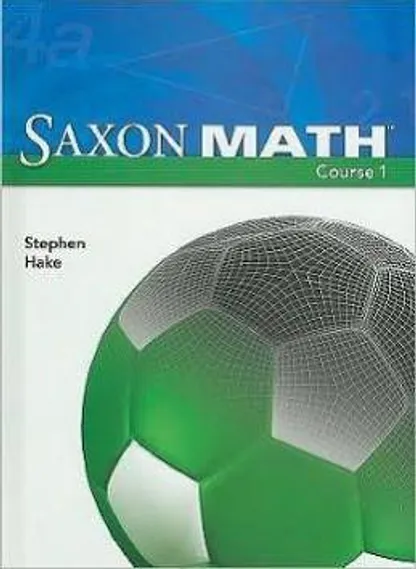
Saxon Math Course 1
Saxon Math Course 1 is the classroom (school) edition for sixth grade, covering the same content as Saxon Math 7/6 in a hardcover textbook format. Nicole the Math Lady provides video lessons and grading for the 4th edition — a great fit for schools, charters, and co-ops.
Homeschooling? See Saxon Math 7/6 (homeschool edition)Lessons taught & reviewed by Nicole Thomas · Updated October 2026
What Saxon Math Course 1 Covers
- Fractions, decimals, and percents
- Ratios and proportions
- Integers and the coordinate plane
- Geometry and measurement
- Introduction to algebraic thinking
Saxon Math Course 1 Table of Contents
The full lesson-by-lesson scope and sequence for Saxon Math Course 1, so you know exactly what your student will learn before you start.
132 lessons
Lesson 1·Adding Whole Numbers and Money/ Subtracting Whole Numbers and Money/ Fact Families, Part 1
Lesson 2·Multiplying Whole Numbers and Money/ Dividing Whole Numbers and Money/ Fact Families, Part 2
Lesson 3·Unknown Numbers in Addition/ Unknown Numbers in Subtraction
Lesson 4·Unknown Numbers in Multiplication/ Unknown Numbers in Division
Lesson 5·Order of Operations, Part 1
Lesson 6·Fractional Parts
Lesson 7·Lines, Segments, and Rays/ Linear Measure + Activity (Inch Ruler)
Lesson 8·Perimeter + Activity (Perimeter)
Lesson 9·The Number Line:Ordering and Comparing
Lesson 10·Sequences/ Scales
Investigation 1·Frequency Tables/ Histograms/ Surveys
Lesson 11·Problems About Comparing/ Problems About Separating
Lesson 12·Place Value Through Trillions/ Multistep Problems
Lesson 13·Problems About Comparing/ Elapsed-Time Problems
Lesson 14·The Number Line: Negative Numbers
Lesson 15·Problems About Equal Groups
Lesson 16·Rounding Whole Numbers/ Estimating
Lesson 17·The Number Line: Fractions and Mixed Numbers + Activity (Inch Ruler to Sixteenths)
Lesson 18·Average/ Line Graphs
Lesson 19·Factors/ Prime Numbers + Activity (Prime Numbers)
Lesson 20·Greatest Common Factor (GCF)
Investigation 2·Investigating Fractions with Manipulatives + Activity (Using Fraction Manipulatives)
Lesson 21·Divisibility
Lesson 22·"Equal Groups" Problems with Fractions
Lesson 23·Ratio/Rate
Lesson 24·Adding and Subtracting Fractions that Have Common Denominators
Lesson 25·Writing Division Answers as Mixed Numbers/Multiples
Lesson 26·Using Manipulatives to Reduce Fractions/ Adding and Subtracting Mixed Numbers
Lesson 27·Measures of a Circle + Activity (Using a Compass)
Lesson 28·Angles
Lesson 29·Multiplying Fractions/ Reducing Fractions by Dividing by Common Factors
Lesson 30·Least Common Multiple (LCM)/Reciprocals
Investigation 3·Measuring and Drawing Angles with a Protractor + Activity (Measuring Angles)
Lesson 31·Areas of Rectangles
Lesson 32·Expanded Notation/More on Elapsed Time
Lesson 33·Writing Percents as Fractions, Part 1
Lesson 34·Decimal Place Value
Lesson 35·Writing Decimal Numbers as Fractions, Part 1/ Reading and Writing Decimal Numbers
Lesson 36·Subtracting Fractions and Mixed Numbers from Whole Numbers
Lesson 37·Adding and Subtracting Decimal Numbers
Lesson 38·Adding and Subtracting Decimal Numbers and Whole Numbers/Squares and Square Roots
Lesson 39·Multiplying Decimal Numbers
Lesson 40·Using Zero as a Placeholder/ Circle Graphs
Investigation 4·Collecting, Organizing, Displaying, and Interpreting Data
Lesson 41·Finding a Percent of a Number
Lesson 42·Renaming Fractions by Multiplying by 1
Lesson 43·Equivalent Division Problems/ Finding Unknowns in Fraction and Decimal Problems
Lesson 44·Simplifying Decimal Numbers/ Comparing Decimal Numbers
Lesson 45·Dividing a Decimal Number by a Whole Number
Lesson 46·Writing Decimal Numbers in Expanded Notation/ Mentally Multiplying Decimal Numbers by 10 and by 100
Lesson 47·Circumference/ Pi + Activity (Circumference)
Lesson 48·Subtracting Mixed Numbers with Regrouping, Part 1
Lesson 49·Dividing by a Decimal Number
Lesson 50·Decimal Number Line (Tenths)/ Dividing by a Fraction
Investigation 5·Displaying Data
Lesson 51·Rounding Decimal Numbers
Lesson 52·Mentally Dividing Decimal Numbers by 10 and by 100
Lesson 53·Decimals Chart/ Simplifying Fractions
Lesson 54·Reducing by Grouping Factors Equal to 1/ Dividing Fractions
Lesson 55·Common Denominators, Part 1
Lesson 56·Common Denominators, Part 2
Lesson 57·Adding and Subtracting Fractions: Three Steps
Lesson 58·Probability and Chance
Lesson 59·Adding Mixed Numbers
Lesson 60·Polygons
Investigation 6·Attributes of Geometric Solids + Activity (Comparing Geometric Solids)
Lesson 61·Adding Three or More Fractions
Lesson 62·Writing Mixed Numbers as Improper Fractions
Lesson 63·Subtracting Mixed Numbers with Regrouping, Part 2
Lesson 64·Classifying Quadrilaterals
Lesson 65·Prime Factorization/ Division by Primes/ Factor Trees
Lesson 66·Multiplying Mixed Numbers
Lesson 67·Using Prime Factorization to Reduce Fractions
Lesson 68·Dividing Mixed Numbers
Lesson 69·Lengths of Segments/ Complementary and Supplementary Angles
Lesson 70·Reducing Fractions Before Multiplying
Investigation 7·The Coordinate Plane + Activity (Drawing on the Coordinate Plane)
Lesson 71·Parallelograms Activity (Area of a Parallelogram)
Lesson 72·Fractions Chart/ Multiplying Three Fractions
Lesson 73·Exponents/ Writing Decimal Numbers as Fractions, Part 2
Lesson 74·Writing Fractions as Decimal Numbers/ Writing Ratios as Decimal Numbers
Lesson 75·Writing Fractions and Decimals as Percents, Part 1
Lesson 76·Comparing Fractions by Converting to Decimal Form
Lesson 77·Finding Unstated Information in Fraction Problems
Lesson 78·Capacity
Lesson 79·Area of a Triangle + Activity (Area of a Triangle)
Lesson 80·Using a Constant Factor to Solve Ratio Problems
Investigation 8·Geometric Construction of Bisectors + Activity 1 (Perpendicular Bisectors) & Activity 2 (Angle Bisectors & Activity 3 (Constructing Bisectors)
Lesson 81·Arithmetic with Units of Measure
Lesson 82·Volume of a Rectangular Prism
Lesson 83·Proportions
Lesson 84·Order of Operations, Part 2
Lesson 85·Using Cross Products to Solve Proportions
Lesson 86·Area of a Circle
Lesson 87·Finding Unknown Factors
Lesson 88·Using Proportions to Solve Ratio Word Problems
Lesson 89·Estimating Square Roots
Lesson 90·Measuring Turns
Investigation 9·Experimental Probability + Activity (Probability Experiment)
Lesson 91·Geometric Formulas
Lesson 92·Expanded Notation with Exponents/ Order of Operations with Exponents
Lesson 93·Classifying Triangles
Lesson 94·Writing Fractions and Decimals as Percents, Part 2
Lesson 95·Reducing Rates Before Multiplying
Lesson 96·Functions/Graphing Functions
Lesson 97·Transversals
Lesson 98·Sum of the Angle Measures of Triangles and Quadrilaterals
Lesson 99·Fraction-Decimal-Percent Equivalents
Lesson 100·Algebraic Addition of Integers
Investigation 10·Compound Experiments
Lesson 101·Ratio Problems Involving Totals
Lesson 102·Mass and Weight
Lesson 103·Perimeter of Complex Shapes
Lesson 104·Algebraic Addition Activity + Activity (Sign Game)
Lesson 105·Using Proportions to Solve Percent Problems
Lesson 106·Two-Step Equations
Lesson 107·Area of Complex Shapes
Lesson 108·Transformations + Activity (Transformations)
Lesson 109·Corresponding Parts/ Similar Figures
Lesson 110·Symmetry
Investigation 11·Scale Factor: Scale Drawings and Modules
Lesson 111·Applications Using Division
Lesson 112·Multiplying and Dividing Integers
Lesson 113·Adding and Subtracting Mixed Measures/ Multiplying by Powers of Ten
Lesson 114·Unit Multipliers
Lesson 115·Writing Percents as Fractions, Part 2
Lesson 116·Compound Interest
Lesson 117·Finding a Whole When a Fraction is Known
Lesson 118·Estimating Area
Lesson 119·Finding a Whole When a Percent is Known
Lesson 120·Volume of a Cylinder
Investigation 12·Volume of Prisms, Pyramids, Cylinders and Cones/ Surface Area of Prisms and Cylinders
Textbooks You'll Need for Saxon Math Course 1
These are the Saxon Math Course 1 classroom materials and where to buy them.