
Here’s something I’ve learned after many years of teaching math:
A wrong answer can tell us more than a right one.
When your child gets a math problem wrong, it’s easy to assume they weren’t paying attention, forgot a step, or made a careless mistake.
But sometimes, the mistake reveals exactly how your child is thinking.
Research has shown that students often make predictable mistakes because they’re applying a rule they believe is correct.
For example, imagine your child is learning to add fractions.
They see:
And answer:
Why? Because they’ve learned that when adding numbers, you add them together. So they add the numerators (1 + 1) and the denominators (2 + 3).
From their perspective, they’re following a perfectly reasonable rule.
The problem isn’t that they forgot how to add. It’s that they’re applying what they know about whole numbers to fractions, where the same rule doesn’t work.
Why Catching These Mistakes Early Matters
Now imagine your child uses that same approach on their homework today. And tomorrow. And again next week.
Every time they repeat the mistake, they’re reinforcing a rule they believe is correct.
Before long, that incorrect approach becomes a habit.
And the longer a student practices something incorrectly, the harder it can be to unlearn it.
Now we’re not just teaching the correct method. We’re also helping the student understand why the method they’ve been using doesn’t work.
That’s why catching mistakes early is so important.
But, not all mistakes are the same.
Did your child make a careless arithmetic error? Forget a step? Or are they following a rule they genuinely believe is correct?
Each of these mistakes tells us something different, and each requires a different kind of help.
So what’s the takeaway for parents?
It’s simple: You can’t fix a problem you don’t know exists.
This is where the Online Grading Report comes in
Here’s the thing – I love teaching your children math.
But because I’m not there in person, there is one thing I can’t always do.
Catch a mistake as it’s happening and help your child work through it.
That’s where I need your partnership.
Each day your child works on math, take a quick look at the Online Grading Report on your phone.
And simply ask:
Is there anything here I should take a closer look at?”
Maybe everything looks great.
Wonderful. Move on with your day!
Maybe your student missed a couple of unrelated problems but got them right on the second try.
That’s probably not a big deal.
But maybe you notice a lot of incorrect answers, multiple attempts on the same problems, or questions where your child is reaching the retry limit.
Take a look at this example. The student got 10 problems wrong, and even some of the problems marked correct took three attempts.
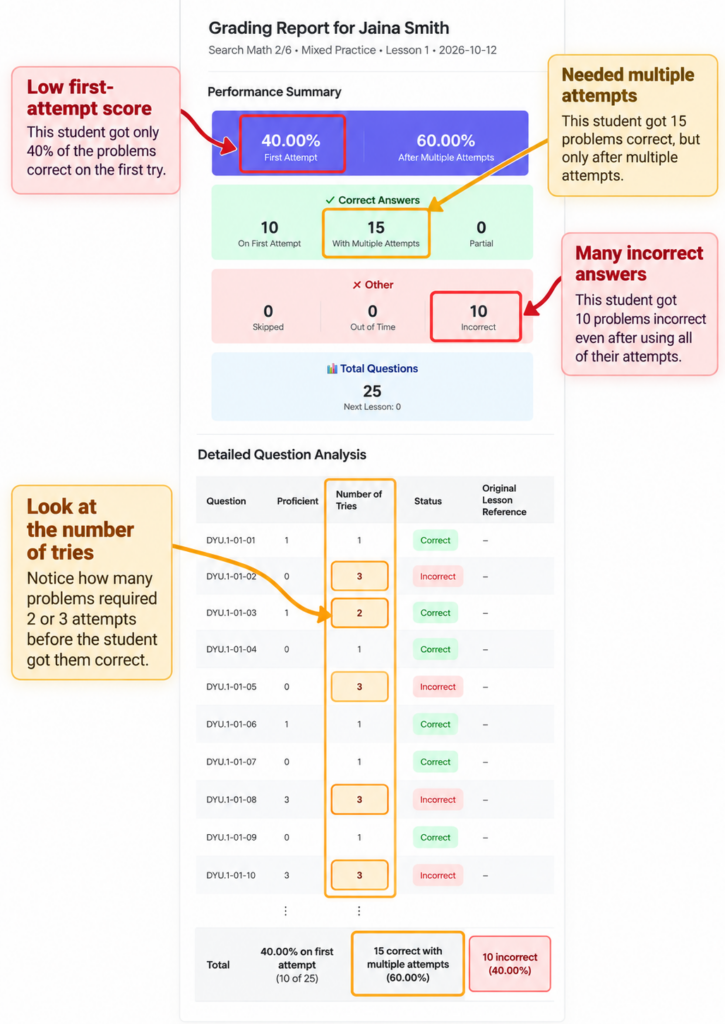
These are exactly the kinds of patterns I want you to notice when you check your child’s Online Grading Report.
You don’t need to analyze every problem. Just look for signs that something might need your attention.
That’s when it’s worth taking a closer look.
That’s the real value of the report.
It isn’t just telling you how many problems your child got wrong.
It helps you spot potential problems before they become bigger ones.
One minute a day can make a difference
This doesn’t need to become another big homeschool task.
Open the Online Grading Report on your phone.
Take a quick look.
Ask yourself:
Are there a lot of incorrect problems?
Are there a lot of multiple attempts?
Are there both?
If the answer is no, you’re done.
If the answer is yes, that’s when you can dig a little deeper.
In my next post, I’ll talk about how you can use the Trouble Spots Report to figure out exactly where your child may be struggling.
Together, these two reports can help you identify misunderstandings early, before your child has a chance to practice the same mistake over and over.
And that’s one of the most valuable things you can do to support your child’s math learning.